The New Employment Leave Act: What’s Replacing the Holidays Act 2003


New Employment Leave Act (Replacing the Holidays Act 2003)

The government has agreed to repeal and replace the Holidays Act 2003 with a new Employment Leave Act that aims to simplify the law and make leave entitlements clearer and fairer for employers and employees. The new legislation is expected to be finalised through the Employment Leave Bill and implemented over a 24-month transition period after passage.

Shift to an Hours-Based Leave System

  • Annual leave and sick leave will accrue continuously in hours from day one of employment, replacing the current system of lump-sum entitlements in weeks/days.
  • Workers earn leave in proportion to hours worked, improving fairness for part-time and variable-hours employees.

Sick Leave Reform

  • Sick leave accrues based on actual hours worked rather than a flat entitlement after six months.
  • Employees can take leave in part-day increments, rather than needing to take a full day off.

Leave Compensation Payment for Casual and Additional Hours

  • For casual employees and for hours worked beyond a contracted schedule, employers will pay a 12.5% leave compensation payment instead of accruing annual or sick leave entitlements.
  • This replaces the current 8% “pay-as-you-go” system for casuals.

Parental, Bereavement and Family Violence Leave

  • Bereavement and family violence leave will be available from the first day of employment.
  • Parents returning from parental leave will receive full normal pay when taking annual leave, addressing previous income reductions.

Simplified Pay and Leave Statements

  • Employers will be required to provide clear, itemised pay statements that show leave accrued and taken, making entitlements more transparent.

Annual Leave Cash-Up Flexibility

  • Workers with large annual leave balances can request to cash up up to 25% of their total accrued leave each year (subject to employer agreement), improving flexibility.

Public Holiday and Alternative Holiday Changes

  • Accrual and entitlement for alternative holidays will also move to an hours-based system.
  • A new clearer test will apply to determine if an employee would have otherwise worked on a public holiday, clarifying eligibility in variable-hours situations.

Why These Changes Are Happening

The current Holidays Act has been widely criticised for being complex to apply, leading to widespread non-compliance, administrative burden, and billions in remediation payments as employers struggled to calculate entitlements correctly. The reforms seek to simplify these rules, reduce compliance costs, and ensure fairness across different types of work arrangements.

Timing

  • The Employment Leave Bill is expected to continue through the legislative process in 2025–2026.
  • Once enacted, there will be a 24-month transition period before full implementation across payroll systems and employment agreements.


Entitlement / Rule Holidays Act 2003 (Current Law) Employment Leave Act (Proposed)
Annual Leave 4 weeks after 12 months continuous employment; then another 4 weeks after each 12-month cycle. Accrues hourly from day one of employment (0.0769 hours leave per contracted hour worked, equivalent to 4 weeks at full time). Leave is banked and doesn’t scale up/down when hours change.
Annual Leave Cash-Up Up to 1 week per year can be cashed up on request (subject to agreement). Can request to cash up 25% of total accrued annual leave each 12 months (by agreement).
Sick Leave 10 days after 6 months continuous employment; then 10 days per year. Capped at 20 days. Taken in full days only. Accrues hourly from day one (0.0385 hours per contracted hour worked, equivalent to 10 days at full time), with cap (e.g., ~160 hours). Can be taken in hours/part-days.
Bereavement & Family Violence Leave Entitlement starts after 6 months continuous employment; taken as full days. Entitlement from day one of employment; can be taken in full or part days.
Public Holidays — “Otherwise Working Day” (OWD) Paid if it’s an OWD based on current definitions; alternative holidays given for working an OWD. Maintains paid public holiday if it’s an OWD, with a clearer test (e.g., 50%+ of corresponding days worked) and more precise hour-based calculations.
Alternative Holidays One alternative holiday per public holiday worked (full day), cashable after 12 months. Hour-for-hour accrual for hours worked on public holidays that are OWDs; can be cashed up (timing subject to final Bill detail).
Casual / Irregular Workers Pay-as-you-go holiday pay option (8%) may apply; sick leave application complex. Leave Compensation Payment: 12.5% of ordinary hourly rate for all hours worked in lieu of annual/sick leave accrual for casuals and hours above contracted hours (if not otherwise compensated).
Leave Pay Calculation Complex formulas under ordinary weekly pay (OWP), average weekly earnings (AWE) for annual leave, and various rules for different leave types. Single hourly leave pay rate for all leave types (based on base wage + fixed allowances), simplifying calculations across leave types.
Annual Leave After Parental Leave Annual leave pay following parental leave is calculated using historical earnings methods (may result in lower pay). Annual leave following parental leave is paid on the same basis as standard annual leave (full normal pay).
Accrual During Absences Annual leave accrues during many paid and some unpaid absences; specifics vary. Annual and sick leave accrues during paid leave and statutory absences (including parental leave), but not during ACC or unpaid leave (policy proposals).
Pay Statements Not specifically required to itemise leave accruals each pay period. Employers must provide clear itemised pay and leave statements each pay period.


Key Conceptual Shifts

Accrual Based on Hours Worked

  • Under the new framework, nearly all leave entitlements accrue in hours from the first day of employment and are proportional to actual hours worked — moving away from annual lump-sum entitlements and rigid service-based thresholds.

Simplified Payments

  • The proposal uses a single leave pay calculation and removes complicated legacy formulas (OWP/AWE), improving clarity for payroll and compliance.

Greater Flexibility for Part-Time and Casual Work

  • Casual workers and those with variable hours receive leave compensation payments in lieu of accrual, and part-days may be taken for many leave types, reflecting modern work patterns.

Status and Timing

  • The Employment Leave Bill is being drafted and will be subject to the parliamentary process, including public submissions and possible amendments.
  • Once enacted, there will be a 24-month transition period before the new system fully replaces the Holidays Act.

Contact Us! 

2026 IRD Updates


2026 Thresholds and Rates

Inland Revenue and government agencies have released updated thresholds and key compliance changes taking effect from early 2026. Below is a summary of the new rates to help you prepare for the upcoming financial year.

ACC Earners’ Levy (2025/26 Income Year)

  • Earners’ levy rate: 1.67% from 1 April 2026 (up from 1.60% currently)
  • Maximum liable income: $152,790 from 1 April 2026 (up from $142.283 currently)

Student Loan Repayments

  • Repayment threshold: $24,128 per year 
  • Repayment rate: 12% on income above the threshold

KiwiSaver

  • The maximum government contribution dropped from $521.43 to $260.72 from 1 July 2025. If you earn more than $180,000 of taxable income a year, you no longer qualify for the government contribution from 1 July 2025.
  • Employee default contribution options are currently: 3%, 4%, 6%, 8%, 10% and the minimum employer contribution is currently 3%.
  • From 1 April 2026 the default rates for both employers and employees will increase to 3.5%, and both default rates will rise again to 4% (from 3.5%) from 1 Apri 2028.

Minimum Wage Rates

  • Adult minimum wage is currently $23.50 per hour, to increase to $24.50 per hour from 1 April 2026
  • Starting-out / Training wage will remain at 80% of the adult minimum wage (i.e. $19.60 per hour from 1 April 2026.

PAYE Tax Rates

  • No new changes to income tax brackets have been announced for 2026.

Inland Revenue has stepped up its approach to overdue tax with faster follow-ups, closer monitoring, and earlier enforcement for businesses that fall behind.

Part of this shift comes from improved technology and automation, which have allowed them to detect overdue balances sooner and respond more consistently.

Carrying tax debt? Act early.

Inland Revenue is far more willing to work with businesses that make contact before debt snowballs. They encourage businesses to clear overdue balances or set up instalment plans straightaway.

Prevention is better than cure

Now is a great time to consider your cashflow for the year ahead, factoring in seasonal dips, late invoices, and potential expenses. But you don’t have to go it alone. If you’re dealing with debt – or trying to avoid it – our accountants and financial advisors are here to help

From SEO to GEO: AI is changing the way customers find your business


For over a decade, Search Engine Optimisation (SEO) has been a major part of a business’s digital presence. Techniques like keyword research, metadata, and backlinks have helped websites appear on the first page of Google for relevant searches.

You’ve probably either dabbled in SEO yourself or hired someone to help push your website up the rankings. But, like so many things, artificial intelligence (AI) is changing the game.

Introducing GEO: Generative Engine Optimisation

Instead of Googling, people are increasingly turning to AI platforms like ChatGPT, Claude, Gemini, and Copilot to find products, services, and local businesses.

AI doesn’t just ‘rank pages’ the way Google does. It gathers information from across the internet and summarises it into answers. If your content is inconsistent, unclear, or rarely updated, AI tools are less likely to include your business in their responses.

What does this mean for SMEs?

After years of building websites that offer a great user experience, you now need to think about the robot experience too.

Here are four GEO tips to help your business stay visible in an AI-led search world:

  1. Accuracy

Make sure your business name, services, pricing, location, and expertise are up to date everywhere you appear online: your website, Google Business profile, social media, and any directories you’re listed in.

  1. Readability

AI prefers content that is clear and easy to read. Keep using personality, humour, and your own unique style; just make sure the language is unambiguous so it’s easy for AI to understand what you do, where you are, and who you serve.

  1. Reputation

Reviews matter more than ever. AI increasingly relies on ratings and customer feedback to decide which businesses to recommend, so encourage clients to leave honest reviews on Google and Facebook.

  1. Structure

Help AI interpret your website by structuring your content clearly. Direct headings, well-labelled services or product descriptions, and a logical flow to your FAQs make it easier for AI to find, trust, and recommend your business.

If you want support with the money side of your business while you navigate the AI shift, get in touch today.


Data security and privacy risks you can’t ignore


Cyber incidents are becoming more common and more sophisticated. Even a single breach can lead to financial loss and reputational damage, and it often starts with something
as simple as a weak password or a
convincing email.

This year, keep an eye out for:

Email-based scams

Phishing is still the top digital threat, with scammers now using AI to create more realistic messages, invoices, and impersonations, so train your staff to spot red flags and run scam-simulation tests.

Ransomware and malware

Outdated software, old devices, and unsecured WiFi networks are all easy entry points for attackers. Turn on automatic updates, do a quick monthly check for anything that needs manual attention, and replace devices that can no longer protect you from malware.

Password protection

After thieves stole precious jewels from the Louvre last year, there was a rumour circulating that the museum’s security password was ‘Louvre’. Whether or not it’s true, it’s a good reminder to use multi-factor authentication and choose long, complex passwords. Hard to remember = hard to guess.

Third-party tools

Online apps for payroll, scheduling, marketing, or sales can be helpful, but if those tools aren’t secure, neither is your data. Always choose reputable platforms with strong security measures.

AI and privacy
AI can help with productivity, but there are big question marks around what it can do with your data. Avoid sharing sensitive information (especially customer details, financial information, and intellectual property) on public AI tools.

Small steps make a big difference. If you’d like help reviewing the security of your financial systems, we can help point you in the right direction.

The down low on the new digital nomad tax


In the August 2025 Tax Bill, the Government proposed new rules for digital nomads, paving the way for overseas remote workers to spend longer periods of time in New Zealand.

Once in place, this bill will allow eligible visitors who work solely for an overseas employer or overseas clients to be treated as non-residents for tax purposes for a longer period when in New Zealand without becoming liable for New Zealand income tax.

To qualify, digital nomads must:

  • not provide services to New Zealand customers and,
  • stay fewer than 275 days in any rolling 18-month period.

Encouraging longer stays means more visitor spending on tourism, hospitality, retail, and local services, all of which will boost our wider economy – and depending on your industry, your business, too.

Can you take a break from tech?


If you run a small or medium-sized business, your brain is probably always half in your inbox. The trouble is, constant connection quickly drains your focus and energy. A few tiny breaks from tech each day can reset your head, your mood, and the way you show up for your team.

Here are six easy ways to unplug and enjoy the benefits of a brief break from tech:

  1. Set one tech-free window each day

It can be as short as 15 minutes; commit to one intentional break from your phone, computer, TV, and tablet — ideally when you’re awake!

  1. Take a walk

The younger generation calls this a ‘silent walk’, but most of us just call it… walking. Skip the earbuds, ditch the podcast, and pay attention to the sights, sounds, and smells of the real world.

  1. Buy a phone safe

If the pull of your phone is too hard to resist, try a timed phone safe. Pop your phone inside, lock it, and revel in the forced freedom. (Phone ’prisons’ can be found online for less than 20 dollars.)

  1. Use Do Not Disturb mode

You’ll still receive urgent calls, but you won’t be interrupted by group chats or never-ending notifications.

  1. Get a notebook

If you reach for your phone without thinking, keep a notebook nearby. Every time you reach for your phone, jot down why you wanted it and how you were feeling. After a few weeks, you’ll start to spot patterns.

  1. Put your phone up high

Just like keys on a hook, give your phone a home – somewhere slightly inconvenient – so you can’t automatically reach for it.

Want to end on a high note? Support your team's mental health

The final stretch of the year can be hectic: deadlines loom, inboxes overflow, and everyone’s racing to wrap things up before the holidays. Add in a packed social calendar, and it’s no surprise stress levels start to soar.

It’s tempting to just push through the silly season, but looking after your people now helps them finish strong and return in January with the energy your business needs to thrive.

Help manage workloads

Overloading December only leads to exhaustion and mistakes. Before setting and enforcing end-of-year deadlines, ask yourself this question: does it really need to be done this year?

Prioritise what’s essential and postpone non-urgent projects until January. Build breathing space into your calendar by leaving realistic gaps between deadlines. And avoid last-minute scrambles by clearly communicating cut-off dates for new work.

Acknowledge your team’s hard work

Recognition boosts morale, but it doesn’t have to be costly. A simple “thank you” goes a long way, whether it’s in a team meeting, a handwritten note, or a thoughtful gesture like finishing early on a Friday. The goal is to make people feel seen and appreciated before the break.

Normalise asking for help

Create a culture where it’s okay to admit when things feel overwhelming. You can do this by…

  • Checking in regularly, both formally and casually.
  • Leading by example. If you’re telling your team to take a break, make sure you do the same.
  • Promote available support. A poster in the kitchen or a company-wide email about wellbeing services can make a big difference.

And if you can see that someone is struggling, point them toward your Employee Assistance Programme or other support options.

The do's and don'ts of holiday sale specials

When run right, Christmas promotions don’t just boost sales, they build trust that lasts well beyond the festive season. Follow these five simple rules to spread holiday cheer without a compliance headache.

Do: offer genuine holiday discounts and Christmas bundle deals.
Don’t: hike your prices beforehand to make your discounts look better than they are.

Do: Be transparent about available stock and time limits.
Don’t: Use countdown timers or “only 2 left!” gimmicks to create a false sense of urgency.

Do: Showcase real, recent customer reviews.
Don’t: Cherry-pick, recycle, or fabricate testimonials.

Do: Keep a close eye on your stock levels.
Don’t: Promote items that are already sold out.

Do: Offer gift cards or vouchers for easy last-minute gifts.
Don’t: Set expiry dates shorter than three years: it’s against
New Zealand law from March 2026.

'Tis the season for giving... but what can you claim back

Gifts, bonuses, parties, and more: here’s a brief breakdown of what you can and can’t claim this festive season.

Employee gifts

Gifts that are not subject to the entertainment tax rules (vouchers, hampers, flowers) are fully deductible and exempt from Fringe Benefit Tax (FBT) if they cost less than $300 per employee per quarter, and the total for all staff stays below $22,500 a year.

However, gifts that do fall under the entertainment tax rules, like food hampers or wine, or taking your team to a show or event, are 50% deductible, and not liable for FBT.

Cash bonuses

Bonuses are classed as income, so PAYE and other payroll taxes apply. These “lump sum” payments are taxed at a flat rate based on your employee’s income bracket.

Client gifts

Food, drink, or entertainment gifts are 50% deductible. Other gifts (flowers, movie tickets, a book) are 100% deductible

Workplace events

Christmas parties, client dinners, or team drinks are 50% deductible, while morning teas, office lunches, and charitable donations are fully deductible.

Remember: GST adjustments apply for entertainment expenses that are 50% deductible.

Not sure where your Christmas spending fits? Contact Us!

How to survive the Christmas cash flow crunch

While retailers race through their busiest time of year, not every business benefits from the Christmas rush. Many service-based, wholesale, or manufacturing businesses might even face a sharp decline in orders just when holiday pay, bonuses, and annual shutdowns see expenses rise.

  1. Forecast to February

Projecting your income and expenses well into the new year helps you spot potential shortfalls and take action before they become problems.

  1. Invoice early, follow up now

Send invoices before your shutdown period and chase outstanding debts while clients are still around.

  1. Prioritise essential spending

Identify what expenses are necessary and what can wait until revenue picks back up.

  1. Prepare for January’s tax obligations

The 15 January due dates for PAYE, GST, and provisional tax can feel like a Grinchy surprise. Set aside funds now to avoid starting the new year under pressure.

Worried about the summer squeeze

If this season feels tight, get in touch. Our financial advisors can help you plan ahead, manage your cash flow, and explore IRD instalment options to lighten the load. Contact Us! 

Where do you sit on the Business Barometer?

How are you feeling about your business right now? Are you on solid financial footing, or taking a more cautious approach? Is demand steady, growing, or unpredictable?

Business confidence is a key economic indicator, and right now in New Zealand, the latest data paint a mixed picture:

Signs of recovery – After a slow period, economic activity has started to pick up with early signs of renewed business momentum.

Cautious optimism – Business confidence is improving, but caution lingers as companies navigate costs, demand, and future economic uncertainty.

Global uncertainty – While domestic trends are improving, global trade tensions and price volatility could still impact supply chains, costs, and long-term stability.

USE THE CURRENT BUSINESS CONFIDENCE TO YOUR ADVANTAGE

Consider your business’s growth strategy. If confidence continues to rise, now could be a good time to expand your operations, invest in new equipment, or explore new revenue streams.

Hiring and workforce planning. Business optimism often fuels recruitment and team expansion. Confidence is on firmer ground, but uncertainty remains. If hiring, focus on roles that support long-term growth. If caution is needed, consider upskilling existing staff instead.

Market positioning. Shifting confidence levels can change customer spending habits. Are there opportunities to refine your pricing, enhance your marketing efforts, or introduce premium services that align with shifting demands?

Financing decisions. If borrowing costs continue to ease, consider refinancing loans at a lower rate or securing funds for expansion—just make sure you weigh affordability before taking on new debt.

Understanding the current business climate is key to making informed financial decisions. Want tailored insights for your industry? Contact us!

Tax and Cash Flow Planning

A new tax year isn’t just about compliance — it’s a chance to strengthen your financial foundation, optimise cash flow, and reduce stress. Smart planning now can set your business up for long-term success.

STEP 1: GET TAX-READY

A fresh financial year isn’t just about keeping up with tax rules—it’s a chance to set stronger financial foundations for the future.

  • Assess your tax situation. Check for upcoming tax liabilities and savings—review deductible expenses, tax bills, and opportunities to defer or prepay costs.
  • Keep your records in order. Well-organised invoices, expenses, and payroll records prevent last-minute headaches. If your records need work, start building better habits now to streamline future tax seasons.
  • Address any tax debt early. Inland Revenue is tightening compliance on undeclared income, GST, and payroll reporting. Stay ahead by reviewing your tax obligations now. If you’re struggling, we can help liaise with Inland Revenue and arrange a payment plan to get you back on track.

STEP 2: STRENGTHEN CASH FLOW

A tight cash flow strategy helps you stay resilient through economic shifts and unexpected expenses.

  • Forecast upcoming expenses. Identify any major costs this year and plan your budget accordingly.
  • Analyse last year’s financials. Look for trends, unexpected costs, and areas for improvement. Use this data to refine your financial plans for the year ahead.
  • Review pricing and margins. Are your prices still competitive and profitable? Make sure your pricing reflects rising costs, supplier pricing, and shifting customer demand.
  • Optimise invoicing. Consider eInvoicing to speed up payments and reduce admin delays. Encourage prompt payment by setting clear terms and automating reminders.
  • Build a buffer. A cash reserve can protect against slow months or surprise costs. Even setting aside a small percentage of revenue regularly can make a big difference.

A new tax year brings new opportunities—with the right financial strategy, you can make the most of them. If you need tailored advice, Contact us!

Niching, Micro-Influencers, and TikTok can grow your business


Some of today’s most effective business strategies come straight from Gen Z playbooks, but they’re not just for the young. These three trends are helping all sorts of businesses connect with customers in smarter, more authentic ways.

Find your niche

If you’re trying to appeal to everyone but getting lost in the crowd, it might be time to narrow your focus with a strategy known as niching.

Think bookkeeping services tailored to freelance creatives who hate spreadsheets. Or a job scheduling app that helps tradies manage tools and timelines with ease.

By offering something more specific, you might have a smaller pool of people, but it’ll be easier for them to find you and recognise your value straight away. Plus, niche businesses benefit from lower ad spend, stronger branding, and more loyal customers.

Work with micro-influencers

You don’t need a Kardashian, you just need someone your audience trusts.

Micro-influencers (typically with 10k–100k followers) have strong engagement and dedicated communities. A local foodie, fitness coach, or real estate agent. They’re relatable, cost-effective, and their endorsements feel real because they are.

Start by searching Instagram or TikTok using hashtags related to your niche, or ask your customers who they follow. Many micro-influencers are open to partnerships: just reach out with a clear idea of your product, values, and what you’re offering.

It’s TikTok o’clock

No, it’s not a real clock (and no, you don’t have to dance!).

TikTok has become a discovery engine for small brands. The app’s algorithm favours authenticity over polish, so you don’t have to hire a social media manager to post daily: even one well-made post can take off. Use it to show behind-the-scenes moments, answer FAQs, or share real customer stories.

Dipping your toes into modern marketing?

If this all sounds like a different language, you’re not alone.

Ask your kids or grandkids for a few pointers. Sign up to social media and follow small businesses you admire. Attend a digital marketing course to help break it all down. Or better yet, have a chat with someone younger in your network; they might be the shortcut you need into this new world of marketing.

Think you’re ready to grow? Ask yourself these 4 questions first.


Growth is exciting, and with the right planning, it can be a turning point for your business. But whether you’re taking on more clients, expanding your services, or launching into a new market, it’s important to first make sure your financial foundations are solid enough to support what’s next.

Here are four key questions to ask yourself before scaling up:

Do you have enough cash flow for the next stage?

Growth often means spending before you earn. You might need to stock up on supplies, hire more staff, or invest in new technology. Do you have the working capital to manage that gap? If not, it could be time to explore funding options, stagger your expansion, or adjust your timeline.

Are your systems and processes built to scale?

Can your current invoicing, inventory, and reporting systems handle increased demand? Review your software, automate what you can, and build in capacity now so your systems won’t buckle under the pressure of a larger operation.

Is your pricing model sustainable as you grow?

Bigger business brings more overheads and greater complexity. Are your current margins wide enough to cover these costs? Now’s the time to adjust your pricing so it reflects the extra time, effort, and resources needed to deliver at scale without eating into your profits.

Are there any tax or compliance implications?

Business growth can push you into new tax brackets, GST thresholds, payroll obligations or even overseas tax obligations if you are dealing with overseas customers or doing business overseas. Make sure you stay compliant. The last thing you want is a surprise tax bill just as your momentum is building.

Ready to grow, but unsure where to start? Let’s chat about your financial readiness and help you plan for sustainable success. Contact us now!

Are your ads playing by the rules?

You’re not trying to deceive anyone; you just want to stand out in a crowded market. But under the Fair Trading Act, even well-meaning marketing can land you in hot water with the Commerce Commission if it’s misleading.

  1. Overpromising

If it sounds too good to be true, the Commerce Commission takes notice. Be careful with bold claims, and only promise instant results if you can prove it.

  1. Hidden catches

It’s great to highlight the best parts of a sale, just don’t let important terms and conditions get lost in the fine print. Customers appreciate clarity.

  1. The urgency trick

There’s nothing wrong with a ‘Today Only’ deal…so long as it doesn’t run all week! In 2022, false urgency tactics earned online retailer 1Day an $840,000 fine.

  1. Misleading language

In 2023, One NZ copped a hefty $3.675 million fine for a number of charges including advertising ‘FibreX’ as fibre broadband when it was copper. That false promise crossed the line, but even vague language can be a red flag. Always stick to clear, accurate wording.

  1. Price hikes and fake sales

Make sure your sale prices reflect a genuine deal… because bumping up prices before a sale to make a discount look bigger isn’t a real saving!

The takeaway?

Being clear, honest, and upfront is the best way to earn trust and keep both your customers and the Commerce Commission happy.


Does the new Investment Boost tax break affect you?

From 22 May 2025, businesses can take advantage of the new Investment Boost tax deduction.
This allows you to claim 20% of the cost of eligible new assets upfront and depreciate the
remaining 80% as usual. See Inland Revenue’s website for more details and examples.

Not sure how this applies to your business? Get in touch — we’re here to help.


Government Grants, Loans, and Support Programmes

There are a number of government grants, loans, and support programmes in New Zealand for businesses looking to expand globally. Below is a summary of key options, particularly relevant for businesses making an international push:


1. Callaghan Innovation – Research and Development Support

If your global play involves innovation, R&D, or tech development:

  • R&D Tax Incentive: 15% tax credit on eligible R&D expenditure

  • Project Grants and Growth Grants: Targeted support for commercialising R&D outcomes

  • Support for product development and prototyping


2. New Zealand Trade and Enterprise (NZTE) – Export and International Growth Support

NZTE is the primary government agency supporting NZ businesses to go global:

  • International Growth Fund (IGF): Co-investment support for businesses investing in international growth projects (e.g., market entry, partner development, capability building)

  • Export Essentials Programme: Workshops and tools to help you develop a global strategy

  • Beachheads and Global Network: Access to advisors and support offshore

  • Focus customers can get co-funding for market research, branding, IP, legal and distribution support


3. Regional Business Partner Network (RBP)

Managed jointly by NZTE and Callaghan, this is a first port of call for small to medium enterprises (SMEs):

  • Capability Development Vouchers: Co-funding (up to 50%) for business services such as business planning, export strategy, marketing and IP

  • Referral support: Can refer you to NZTE customer managers or Callaghan Innovation advisors


4. MBIE – Strategic Support Initiatives

While not grant-based, MBIE provides:

  • Support via the Business.govt.nz portal: Tools and guides for international trade, scaling up, IP protection, and export compliance


5. Export Credit Office (NZECO) – Treasury

Provides insurance and financial guarantees to help exporters secure international contracts and funding. Particularly helpful for:

  • Winning overseas contracts

  • Offering extended credit terms to buyers

  • Securing working capital


6. Other Possible Support

  • Industry-specific funding may be available (e.g. agritech, manufacturing, gaming, biotech)

  • Māori Business Support via Te Puni Kōkiri, the Māori Economy team at NZTE, and the Poutama Trust

  • Sustainable Business and GreenTech Expansion support through EECA and MBIE


Suggested Next Steps

  1. Engage with the Regional Business Partner Network to access vouchers and get referred to NZTE or Callaghan

  2. Apply to become an NZTE “Focus” customer if your business is in a strong growth phase

  3. Consult with a business advisor or accountant (like us) to identify eligibility, draft proposals, and manage compliance for grants

Commercial Property and Businesses Changes

If you’re investing in commercial property, keep your eyes peeled for further details about the new Investment Boost from Budget 2025.

From 22 May 2025, for new commercial and industrial buildings (not residential), IRD says businesses can claim 20% of the cost of new assets as a tax deduction – provided they’re used or available for use from that date.

Please note, the deduction will likely be clawed back through depreciation recovery when you eventually sell, but until then, it’s a decent interest-free loan!

Example:

  • Build a new commercial building for $1.5m, debt-free.
  • Initial tax deduction at 20% = $300,000.
  • Rent it out for $100,000 a year.
  • Even without chattels depreciation or other deductions, you wouldn’t pay tax on the rental income for the first three years

What assets does Investment Boost cover?

Investment Boost applies to the purchase of most new assets that are depreciable for tax purposes – common examples include machinery, equipment and work vehicles. Investment Boost also applies to the purchase of new commercial buildings, which do not allow depreciation deductions. Second-hand assets are generally not eligible for Investment Boost, but those that are sourced from overseas may be able to claim the deduction

Example of Investment Boost in practice for businesses

An advanced manufacturing firm decides to invest in an environmental test chamber to analyse how its products withstand extreme temperature conditions. The chamber costs $200,000. Under the status quo, the company can claim annual depreciation deductions of 10.5 per cent of the value of the chamber. This deduction reduces its taxable income in the year it purchases the machine by $21,000. With Investment Boost, the company can claim 20 per cent of the value of the chamber ($40,000) as a tax expense in the year of purchase, in addition to the 10.5 per cent annual depreciation deduction on the remaining 80 per cent of the value of the chamber ($16,800).

Together, these deductions reduce its taxable income in that year by $56,800. Compared to making the investment under the status quo, Investment Boost means the company can deduct an additional $35,800 from its taxable income in the year it purchases the chamber. This translates to a reduction of over $10,000 in its tax bill, as the company tax rate is 28 per cent, and 28 per cent of $35,800 is $10,024. At the same time, the depreciation deductions it receives in future years will be smaller because it has claimed more deductions in the first year. The company can make use of the timing advantage of receiving deductions earlier by reinvesting its additional after-tax income to increase its future returns.

What assets does Investment Boost not cover?

To ensure Investment Boost is most efficiently lifting productivity, some assets are not eligible for the deduction, including: • assets that have previously been used in New Zealand • land (although land improvements, such as fencing, may be eligible) • assets that will be held as trading stock • residential buildings (dwellings) • fixed-life intangible assets (such as patents) • assets that are fully expensed under other rules (e.g., assets valued below $1000

Key aspects of Investment Boost:

  • 20% Immediate Deduction:

Businesses can claim an immediate 20% tax deduction on the cost of eligible new assets.

  • Depreciation on Remainder:

The remaining 80% of the asset’s cost can be depreciated as usual.

  • Eligible Assets:

The initiative applies to most new depreciable assets, including machinery, equipment, and work vehicles.

  • New and Second-hand Overseas Assets:

Investment Boost can be claimed on second-hand assets purchased from overseas on or after May 22, 2025, but not on those traded within New Zealand.

  • Focus on Productivity:

The government hopes the initiative will encourage businesses to invest in assets that boost their productivity.

  • No Exclusions for Size:

All businesses, regardless of size, can benefit from the Investment Boost.

  • Example:

If a business buys a new machine for $100,000, they can deduct $20,000 in the first year under Investment Boost. They can then depreciate the remaining $80,000 in subsequent years.

  • Implementation Date:

The initiative is effective for assets first used or available for use on or after May 22, 2025.

The perks of tax pooling

Keeping a lump of cash aside to pay provisional tax on your Inland Revenue due dates can be challenging for any business, especially if you have cashflow issues and need money on hand. For some companies and sole traders, tax pooling is the perfect solution.

What’s tax pooling?

Being part of a tax pool provides more flexibility on when you pay provisional tax to Inland Revenue, rather than being tied to the IRD’s deadlines.

How it works

IRD-approved intermediaries such as TMNZ or Tax Traders transfer money to Inland Revenue on your behalf. Once the pool has made the payment to IRD, it is considered ‘tax paid’.

All you have to do is keep up with your payments to the pool or purchase tax payments with a finance charge. This allows you to better make payments to help your cashflow.

Tax pools provide flexibility, allowing you to overpay when you have a bit more money and giving breathing room when things get tight. Overpayers help other businesses in the pool that need more time to make their payments.

The pros of tax pooling

  1. You’ll avoid IRD’s penalty charges and use of money interest (UOMI) charges for late payments as the pool will always make time-stamped payments for you.
  2. If you haven’t paid enough tax to meet your provisional tax liability, tax pools typically charge lower interest rates for purchasing tax payments than those charged by IRD.
  3. You can dip into your tax pool payments and use them as an emergency line of credit if you’re short on cash, as long as you top up the money later.
  4. If you take money out of the pool, you’ll be charged a lower rate of interest than those charged by the banks.

In short, tax pools can give you more control over your provisional tax obligations. Talk to us today to see if tax pooling is the right fit for you.

Got March balance dates?

Remember your first provisional tax instalment is due this month, on August 28. Here’s a breakdown of your key dates this year:

  • 1st instalment: 28 August
  • 2nd instalment: 15 January
  • 3rd instalment: 7 May


Mixed-use asset rule change explained

April 1 marks a significant change in the GST tax treatment of mixed-use assets.

Taxpayers can claim 100% of GST for expenses relating to the income-earning use of a mixed-use asset, for example, the cost of advertising a holiday home online.

However, working out GST claims for expenses relating to both the income-earning and private use of the asset has been more difficult to establish.

In the past, a complex calculation has been needed to apportion GST expense claims relating to both income-earning and private use.

As of this month, GST calculations for mixed-use assets have been simplified. You no longer need to use the old method and general apportionment and adjustment rules will apply instead.

Remember, if you have a mixed-use asset, such as a boat, bach, or plane, please keep records on how and when it is used for business or private purposes.

If you’re unsure about these changes, give your adviser a call.

Your 12-point checklist to stay ahead on tax

1. Contracts

Have you invoiced retentions that don’t need to be paid until next year? If they are payable this tax year, they will be classed as taxable income for 2023-24. Unsure? Talk to us as your tax adviser.

2. Employee expenses and holiday pay

Holiday pay, bonuses, redundancy payments, and long service leave owed to employees can be claimed this year if you have committed to them at year-end and pay them within 63 days of the balance date.

Also, ensure holiday pay has been calculated correctly to avoid time-consuming revisions once the tax year is over. Find more information here or visit the Employment NZ website.

3. Credit notes

Take stock of credit notes issued to customers after the balance date. You may be able to apply them to the current tax year and reduce your taxable income.

4. Expenses

Find out if you can prepay expenses before March 31 for items such as stationery, postage, and courier charges to claim deductions sooner.

5. Debtors

Before the end of March, review your debtors and make a list of any outstanding bad debts. Ensure your records show you’ve taken reasonable steps to recover bad debts. Bad debts written off before March 31 can often be claimed as a deduction.

6. Fixed assets

If you’re not using some of your assets, you may be able to write them off.

7. Tax losses (carryforward, offsets and subvention payments)

Set to make a loss in the current financial year or have tax losses from prior years? Talk to us as soon as possible about carryforwards, loss offset elections and subvention payments.

8. Discounts for prompt payment

If you’ve offered prompt payment discounts over the tax year and maintain a discount reserve, this might be deductible. Make sure you keep clear records about any discounts.

9. Repairs and maintenance

Thinking about doing repairs or maintenance? Get it done before the year-end to ensure you get your deductions sooner. Consider software development and improvement costs as part of this.

10. Dividends and imputation credits

Review your dividend payments for the year by March 31. Imputation credit accounts mustn’t have a debit at the year-end, or you could be hit with penalties.

Also, review deemed dividends (for example, overdrawn shareholder current accounts with no interest charged).

11. Stock

Dispose of obsolete stock by year-end or write it down to its net realisable value (the lesser of cost or market value).

If your stock is worth less than $10,000 and your turnover is less than $1.3 million for the year, you won’t need to include stock movements for tax purposes.

12. FBT

Review all FBT items. Have you taken account of possible exemptions? The FBT March quarter return is the year’s last quarterly return and will most likely require a wash-up calculation.

GST and the new Airbnb/Uber Tax

GST and the new Airbnb/Uber Tax

If you offer accommodation or ride share services in New Zealand via an electronic marketplace (e.g., Airbnb or Uber), new GST changes will impact on you from 1 April 2024, although the National Party has stated it will repeal the change if they are elected to Government in October this year.


At present, providers of these services are not subject to GST if their turnover is below the $60,000 GST registration threshold. However, the Tax Bill which passed through select committee on 2 March 2023 now imposes GST on accommodation and transport services provided through electronic marketplaces, regardless of whether or not the owner of the property or the driver is registered for GST. The Bill is likely to be passed into legislation in the coming weeks.


What is changing

The Taxation (Annual rates for 2022-23, Platform Economy, and Remedial Matters) Bill (No 2) creates a category of services called ‘listed services’ which incorporate all commercial, short-stay and visitor accommodation (such as Airbnb, Bookabach and Booking.com), as well as all ride-share and food and beverage delivery services (such as Uber, Ola and Lyft).


This change means the marketplace operator is deemed to be the supplier of the services and is required to collect and return GST at 15% on all services provided to end-users through their marketplace.


The supply between the marketplace operator and a GST registered property owner or driver will be zero rated for GST. For example, Sarah is GST registered and rents out a property via the Airbnb marketplace for $100 a night. Airbnb is deemed to be the party supplying the accommodation and adds GST to the nightly rate, therefore charging guests $115. Airbnb pays the $15 GST to the Inland Revenue. The transaction between Airbnb and Sarah is zero-rated, therefore Sarah includes $100 as a zero-rated supply in her GST return.


If the property owner or driver is not GST registered, the marketplace operator deducts 8.5% input tax from the taxable supply (referred to as a flat-rate credit), and passes that 8.5% credit to the property owner or driver. The flat-rate credit is intended to approximate the amount of GST that the property owner or driver could claim as input tax if they were GST registered. Therefore, if Sarah was not GST registered, she would receive a credit of $8.50 (8.5% of $100) from the marketplace. The marketplace will return net GST of $6.50 to the Inland Revenue ($15 – $8.50). Current commentary is unclear on how Sarah treats the credit in her income tax return and no doubt detailed guidance will be provided once the legislation is passed.


What are the exemptions

Large commercial enterprises who offer over 2000 nights of short-stay accommodation per year via a marketplace enter into an agreement with the marketplace operator to opt-out of the new rules and allow them to continue being responsible for their own GST obligations.


In a nutshell

Ultimately there should be no change to GST registered property owners’ or drivers’ back pockets, while non-registered property owners or drivers may have additional income to declare in their tax returns due to the flat-rate credit. Although non-registered property owners or drivers could voluntarily register for GST, this may not be the ideal solution for property owners.


If you require assistance in understanding how you will be impacted by this new GST rule, please contact us.

Fundamental GST changes coming your way

Fundamental GST changes coming your way

Ever since GST was first introduced in 1985, businesses have become very familiar with various aspects of GST which have been fundamental to meeting their GST compliance obligations.


Under the guise of “modernising GST” the Inland Revenue is introducing a number of invoicing and record keeping changes that will apply from 1 April 2023.

These changes have two stated purposes being:

  • To reduce the cost of doing business; and
  • To support e-invoicing and electronic record keeping.


As part of these changes, there will be a number of key terminology changes:

  • Tax Invoice will become Taxable Supply Information
  • Debit/ Credit Note will become Supply Correction Information
  • Buyer-created Invoice will become Buyer-created Taxable Supply Information.

From 1 April 2023, there will no longer be a requirement to keep a single physical document holding the supply information.  Instead, various information contained in your accounting system and contract documents may be used to support the numbers used in your GST returns.  The thresholds for when you need to hold Taxable Supply Information will also increase.


Whilst clearly the way businesses transact has changed since GST was first introduced, the changes from 1 April 2023 could potentially add additional compliance costs for some businesses as their support for various supplies may need to come from multiple sources/ locations, rather than the old tax invoice.


The above changes are not compulsory and businesses can continue to issue tax invoices and credit/debit notes as they have in the past.  You may however find over time that some of your suppliers will change what documentation they produce and you will need to ensure you have sufficient other Taxable Supply Information documents to support any GST claims made.


The Inland Revenue have stated they will be issuing more information on this, leading up to the date these changes come into effect.


In the meantime, if you have any questions on how the GST changes will affect you, please contact us.


GST Special Alert 2023


New rules on GST invoicing apply from 1 April 2023. These changes have been designed for 21st century business record-keeping and modernise invoicing rules in place since 1986, based on paper-based record-keeping systems.

The rules are permissive, so businesses can issue current tax invoices without falling foul of the new rules. However, this doesn’t mean you can ignore them. Your suppliers and customers may introduce changes to their systems stemming from the new rules. You need to be ready to cope with receiving ‘taxable supply information’ in different formats, as opposed to a ‘tax invoice’.

It’s important to note there are no changes to the imposition or calculation of GST – these new rules only relate to information requirements.

A major component supporting the GST system’s integrity is the provision of prescribed information about taxable supplies contained in a tax invoice. Considerable changes have occurred in business practices relating to transactional information and technology since GST’s introduction over 35 years ago, and the new rules reflect this. They are less prescriptive, allowing the way supply information for goods and services is created, provided, and retained to be determined as part of normal record-keeping processes.

From 1 April 2023 businesses must retain a minimum set of information relating to transactions, and are no longer required to issue a ‘tax invoice’ for GST purposes. Don’t forget, however, that normal commercial and contract law still require invoices and record-keeping requirements. Invoices must still be used to notify the customer of their obligations for a taxable supply, but from 1 April 2023 an invoice will not need to meet the old prescriptive requirements such as displaying the words ‘tax invoice’.

‘Taxable supply information’ is effectively replacing tax invoices and must be retained and able to be provided.

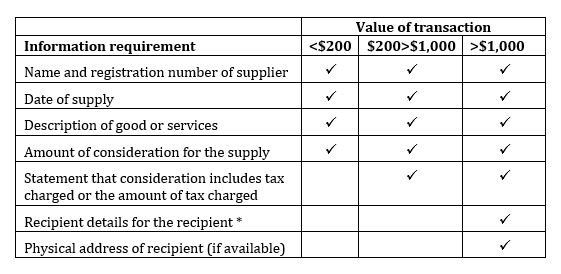
The information required is dependent on the value of the transaction.

* Recipient details require the name of the recipient and one or more of the following:

  • Address of a physical location
  • Telephone number
  • Email address
  • Trading name other than the name of the recipient
  • New Zealand business number (NZBN)
  • Website address

Requirements around credit and debit notes are similarly revised. Formal GST credit and debit notes will no longer be required, however information known as ‘supply correction information’ must be retained. This includes information on inaccuracies corrected such as incorrect descriptions of goods or services, places/times of supply or suppliers/customers.

You must provide supply correction information where the taxable supply information previously provided to a recipient has an incorrect amount of GST, or where you included the incorrect amount of output tax in a GST return. You must provide this information by a date agreed between you and the recipient, or if no date is agreed, within 28 days of the date of the taxable supply information that contained the mistake.

Where the GST shown in the taxable supply information is greater than the eventual GST charged due to a prompt payment discount or an agreed discount which are part of usual business terms, you won’t have to provide the supply correction information.

What about Buyer-Created Tax Invoices?

New buyer-created taxable supply information follows the same criteria as the normal taxable supply information, depending on the value of the transaction, i.e. whether it’s less than $200, or up to $1,000 etc. More importantly, you no longer need Inland Revenue approval to use buyer-created taxable supply information (previously required for buyer-created tax invoices). However, both parties to a buyer-created taxable supply arrangement must agree that only the recipient will provide buyer-created taxable supply information and you must record the reasons, if they are not part of the normal terms of business between the parties.

Note any existing Inland Revenue approvals to use buyer-created tax invoices are not affected.

Even though the new rules still allow ‘tax invoices’ to be issued after 1 April 2023, it is important to make sure you think about:

  • Your accounts payable processes. Do your systems or staff automatically reject invoices which don’t have the words ‘tax invoice’ on them? If so, review this as your suppliers (and customers) may update their systems for the new rules. You may receive invoices after 1 April 2023 which don’t have these words on the invoice. The same will apply for credit notes, debit notes and buyer-created tax invoices.
  • Your information management systems. Review your systems to ensure supplier and customer databases can handle the taxable supply information requirements, especially recipient information (e.g. physical address and NZBN options).
  • Reviewing arrangements with suppliers and customers where buyer-created invoicing is more appropriate. Where you are entering into new buyer-created taxable supply information arrangements, you will need to retain the correct records (including copies of the agreements).
  • The time of supply rules. Certain transactions will have a different time of supply to the date the invoice is created. From 1 April 2023, the time of supply must be included in taxable supply information.
  • Training your staff on the new rules, including on what is required to support GST input tax deductions. As well as a refresher on GST, it will also give you the opportunity to review supplier/customer arrangements and ensure all business/trade terms are current and comply with the new rules.
  • Progressing towards e-invoicing if you haven’t already. These new GST invoicing rules have been introduced to cater for technology and business processes. More efficient invoicing processes could benefit your business.

April 2023 is not that far away. Please contact us to help you assess what your business may need to do before then!

GST invoicing changes are coming!


New rules modernising GST invoicing and record-keeping requirements will apply from 1 April 2023. The key change is removing the requirement to issue and hold a “tax invoice” document (which meets certain prescribed requirements on details required), and instead having GST requirements met provided specific GST information is held through various business records, for example commercial invoices or agreements.

Tax invoices will be replaced by taxable supply information (TSI). This is a set list of information that must be provided to any GST-registered customers within 28 days of the date of supply. Information over and above current tax invoice requirements includes:

  • the ”date of the supply” — when the time of supply is triggered, rather than the current tax invoice requirement of the date on which the tax invoice is issued
  • for supplies over $1,000, the TSI must include the recipient’s physical address (if that information is available).

For supplies over $200 it will become mandatory to issue TSI to GST-registered customers within 28 days of the date of supply, and for supplies made to non-GST registered persons you have 28 days from when the customer requests the information.

Other favourable changes include the increase of the low-value threshold from $50 to $200 where limited taxable supply information is required and the removal of IRD approval for issuing buyer-created tax invoices (to be replaced by written agreements between parties to confirm self-billing).

The new invoicing rules have been designed with the intent that businesses issuing valid tax invoices now would not have to make any changes to comply with the new rules, however all businesses will need to be aware of the changes to ensure their business processes can manage the new GST requirements (i.e. accepting invoices which don’t have the words “tax invoice” on them).

We will have more information for you about the changes over the coming months.

Residential Rental Property Tax

There are many tax implications when investing in residential property in New Zealand. Property investment and understanding the impact of current tax laws and their application is rather complex now, Please seek professional advice when you are unsure of the implications, as mistakes can be costly!

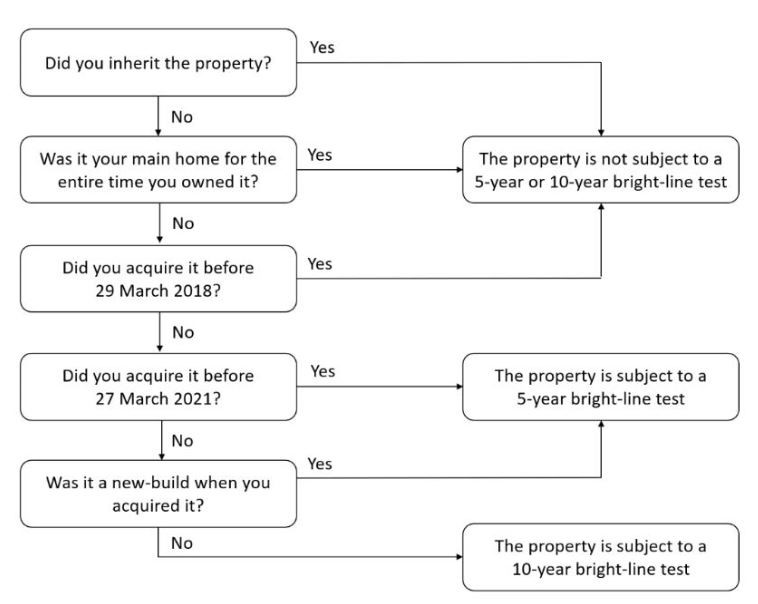
The Brightline test

For sale and purchase agreements that become unconditional on or before 27 March 2021, the “old” Brightline test is applied.

All other properties with a settlement date on or after 28 March 2021 will be subject to the revised Brightline test.

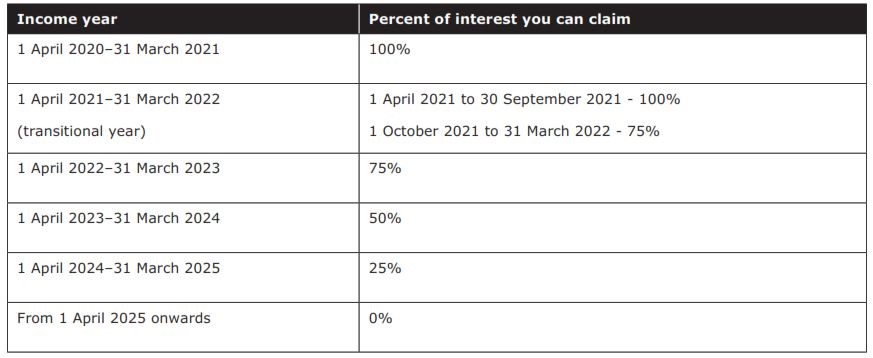
Interest deductibility

  • Property purchased on or after 27 March 2021 – interest can be claimed up to and including 30 September 2021. After that, no interest can be claimed.
  • Property purchased on or before 26 March 2021 can claim the percentages outlined below.

Ringfencing Rules

Previously, losses from rental properties can be offset against other sources of income (wages, salary, business income), thereby reducing an individual’s tax liability.

From 1 April 2019 any loss made from a rental property will be ring-fenced. It will be contained within the rental itself and used on a ‘portfolio basis’. The two types of property income losses can be offset against are:

  • Future residential rental income from across your portfolio; or
  • Any taxable income on the sale of residential land.

Any losses left over will stay ring-fenced to be used in the future against this type of income, ie future residential rental income only and cannot be offset against other personally derived income to lower your overall tax payable, potentially giving rise to a refund

What Expenses can be Claimed

Income from residential property rental should not be declared for GST, and any costs shouldn’t be claimed for GST, either.

Property-related expenses

  • Rates
  • Insurance
  • Property management fees
  • Repairs and maintenance
  • Travel to and from your property for inspections and repairs

Financing expenses

  • Mortgage repayment insurance
  • Loan fees
  • Interest on mortgage*

Legal and consulting fees

  • Legal fees incurred when buying a rental property (if less than $10,000)
  • Legal action to recover unpaid rent
  • Costs for evicting a tenant
  • Preparation of a tenancy agreement
  • Accountancy fees
  • Valuation fee to obtain a mortgage (but not insurance valuations)
  • Legal fees for selling the rental property (if your total legal fees are less than $10,000)

Non-deductible costs

  • Mortgage repayments (except interest*)
  • Interest subject to the new interest deductibility rules announced 23 March 2021
  • Repairs and maintenance, if it increases the value of the asset
  • Insurance valuations
  • Legal fees for selling the rental property (if your total legal fees exceed $10,000)**
  • Advertising the sale of a rental property**
  • Real estate commission**

With the government’s new housing plan announced on 23 March 2021, claiming interest against residential rental income has become severely restricted. If you’re purchasing a rental property, assume that interest cannot be claimed.

For properties acquired on or after 27 March 2021:

  • Legislation has passed that extends the bright-line test from five years to 10 years on residential property.
  • The Government intends for the bright-line test to remain at five years for new builds and will be consulting on what a new build is soon.
  • Legislation has passed that introduced a ‘change of use’ rule. If the sale of your property is subject to the bright-line test, and you don’t use a property as your main home for 12 months or more, you will be required to pay income tax on a proportion of the profit made through the property increasing in value.
  • The Government has proposed that residential property investors will not be able to offset the costs of the interest they pay on loans to purchase residential property as an expense against their taxable income. A consultation will be held about this, with any law expected to come into effect from 1 October 2021.

Employment Matters


Sick leave entitlement changes

The recent passing of the Holidays (Increasing Sick Leave) Amendment Act increased the employee sick leave entitlement from 5 to 10 days per year. The change comes into effect on 24 July 2021. The day in which the employee’s sick leave increases is based on their next entitlement date and not automatically from 24 July.

Median wage increase

The median wage increased from $25.50 to $27 gross per hour from 19 July 2021. This has implications for employers who may be intending to employ staff on an essential skills visa or residence visa

Covid-19 travel policy

The current pause in the trans-Tasman bubble and Wellington’s recent alert level change serves as a timely reminder that businesses need to plan for on-going travel uncertainty. Make sure you have an updated travel policy in place that covers what to do when an employee’s work or personal trip is extended, and the steps that employees should take when travelling in the bubble.

Covid-19 vaccinations and employees

As the vaccination programme rolls out across New Zealand, you might be wondering what your obligations are as an employer. Make sure you are clear on what you can and cannot do when it comes to Covid-19 vaccinations and your workers. Employment New Zealand has released some guidelines to help employers understand their role in the vaccination process. The guidelines can be found on their website together with a one-page PDF for your workplace.

New Trust Disclosures


With the introduction of the 39% tax rate for individuals from 1 April 2021, the Inland Revenue is increasing the information it collects from trusts to assess compliance with the new tax rate and to monitor how trusts are being used.

Trust disclosure obligations

The additional information that needs to be included in a trust’s tax return (from the 2022 tax year) includes:

  • name, IRD number and date of birth of beneficiaries, settlors and those with power of appointment and removal of trustees
  • financial statements
  • details of settlements
  • details of distributions to beneficiaries

Non-active trusts, charitable trusts, Maori authority trusts, and New Zealand trustees of foreign trusts do not need to provide this additional information.

Increased disclosure obligations to beneficiaries

In addition to the above, from January 2021, trustees need to disclose the following trust information to all beneficiaries, including parents/guardians where the beneficiary is under 18:

  • that they are a beneficiary
  • name and contact details of all trustees
  • that they can request a copy of the trust deed and the financial statements

Trustees can choose not to provide requested information to beneficiaries provided the request has been reasonably considered. The beneficiary does not need to be told the reason for not providing the information.

Change to definition of settlor

There has also been a change to the definition of a settlor.  A beneficiary with a current account greater than $25,000 will now be deemed to be a settlor if a market interest rate or Inland Revenue’s prescribed interest rate is not charged. This can have implications for the beneficiary such as student loan repayments and social assistance.

Purchase Price Allocation Rules


If you are planning to buy or sell a business, you need to be aware of the new purchase price allocation rules that apply to business asset sales as well as commercial property sales. The new rules took effect from 1 July 2021 and impact the way parties allocate the agreed purchase price between tangible and intangible assets.

The new rules overcome the issue of vendors and purchasers allocating different prices to the same asset resulting in a tax mismatch for Inland Revenue. Under the new purchase price allocation rules, the parties either have the option of agreeing an allocation which will be applied for tax purposes by both parties, or if no agreement is made, then a legislative process applies for determining the allocation.

There is a de minimis threshold for transactions where the total consideration is less than $1 million, or if residential land and chattels are involved, the threshold is for consideration of less than $7.5 million.

Reinstatement of Depreciation on Commercial Buildings


Since the 2012 income year the depreciation rate for commercial and industrial buildings had been reduced to 0%. Following the Government’s raft of Covid-19 support measures, depreciation can now be claimed on commercial and industrial buildings from the beginning of the 2021 income year. The reinstatement will mean commercial and industrial buildings are now depreciated at 2% diminishing value or 1.5% straight-line. Residential buildings continue to have a 0% depreciation rate.

If you had previously depreciated your commercial or industrial building prior to the 2012 income year, you must continue to depreciate the building from the 2021 income year. Alternatively, if you own a commercial or industrial building that you held prior to the 2012 income year and you had previously elected not to depreciate, you must continue not to depreciate.

Covid-19 Business Support

 
This lockdown was announced at 17 August 2021 and has triggered three of the government’s existing policies – Resurgence Support Payment, the Covid Wage Subsidy, and the COVID-19 Leave Support Scheme. The terms ’employee’ and ‘business’ below include sole traders and shareholder-employees.

Some information and applications may not be immediately available, so keep checking the MSD website regularly https://www.workandincome.govt.nz/covid-19/index.html

Wage Subsidy Scheme (WSS)

For businesses which expect a loss of at least 40% revenue as a result of this lockdown
• To be paid as a two-week lump sum
• Can only be used for wages, not general operating costs
• $600 per week for each full-time employees
• $359 per week for each part-time employee

Applications expected to open on 20 August from Work and Income NZ.

Resurgence Support Payment (RSP)

The RSP is available if a business incurs a drop of 30 percent in revenue over 7 days, compared with 7 days in the last 6 weeks as a result of the Alert Level increase. For commonly owned groups, the whole group needs to be eligible before each entity can claim the RSP.

For businesses which expect a loss of at least 30% revenue as a result of this lockdown

• To be paid as a lump sum
• Can be used for general operating costs
• The amount is to be the lower of:
• $1,500 plus $400 per full-time equivalent employee (up to 50 FTEs), or
• Four times the actual revenue decline experienced by the business

Leave Support Scheme (LSS)

The LSS provides a two-week lump sum payment of either $585.80 per week for full-time workers, or $350 per week for part-time workers, who must self-isolate and cannot work from home.

For employers to help pay employees who cannot work from home while self-isolating

• $585.80 per week for full-time employees
• $350.00 per week for part-time employees

Short-Term Absence Payment (STAP)

The STAP provides a one-off (once per 30 days) $350 payment for workers who must miss work due to a COVID-19 test and cannot work from home. Further information is available on the MSD website.

Does the new 39% tax rate affect you?


The new 39% marginal rate that applies to all employment income over $180,000 is now in force. Consider how the new rate will affect you and your business.

The 39% tax rate and…

Trusts?

From now on, you’ll need to disclose a lot more information to Inland Revenue in your annual trust tax returns. The additional information will provide the Government with information on how trusts are being used, particularly with the introduction of the new 39% tax rate. As part of their annual income tax return, trustees will now have to disclose:

Financial accounting information, including profit and loss statements and balance sheet items
Loans to related parties
Information on distributions and settlements made during the income year
Names and details of settlors from prior years
Names and details of each person who, under a trust deed, has the power to appoint/dismiss a trustee, to add/remove a beneficiary, or to amend the trust deed.

FBT?

A new Fringe Benefit Tax (FBT) rate of 63.93% will apply for all-inclusive pay above $129,681 and the single rate and pooling of non-attributed fringe benefit calculations. The 42.86% rate for non-attributed benefits will no longer apply. Talk to us about your current FBT profile and we can review it together.

RWT and RLWT?

If you earn interest, this will be taxed at 39% (RWT) from 1 October 2021. If you’re selling property covered by the bright-line test, Residential land withholding tax: (RLWT) will increase from 1 April 2021 to 39% (except where the vendor is a company).

Beneficiary income from a trust?
If you receive beneficiary income from a trust let us know if you’d like to know more about your tax position.

Property or shares?

If you are looking to purchase assets such as property or shares, or already have such investments, it would be prudent to assess your overall investment strategy so that it meets your commercial and personal goals, including your tax profile.

Such investments are able to be held in companies or a trust, which have tax rates of 28% and 33% respectively, however on distribution to individuals in most cases the individual’s tax rate will effectively be applied.

A strong note of caution – the main reason for any restructuring of your investments should not be due to any perceived tax benefits arising out of the restructure. Any restructuring should be focused on achieving key objectives such as successful commercial, risk, succession, and asset protection outcomes. Talk to us and we
can review and assist you with planning to meet your objectives.

Superannuation contribution tax?

Time to check whether you have employees whose Employer Superannuation Contribution Tax (ESCT) and Retirement Savings Contribution Tax (RSCT) rate threshold exceeds $216,000. The tax rate for these has risen to 39% (as of 1 April 2021).

Additional employment income?

The tax change applies to all employment income over $180,000 a year, including bonuses, back pay, redundancy, and retirement payments. As an employer, take account of when additional remuneration to employees may affect their tax obligations and make sure tax is deducted correctly.


From Airbnb to boarders: What’s new for property owners?


Renting your home or bach online?

If you rent a property for short periods, you need to know your tax commitments. New rules announced last May come into force this financial year.

Here’s what you need to know:

2,500 If your tax due at end of year is more than $2,500, you’ll have to pay provisional tax instalments the following year.
60,000 If you earn more than $60,000 a year from your taxable activities, you must register for GST. If you earn less than $60,000 a year, you can choose to register for GST.

If you have the choice, think carefully about whether registering for GST is best for you. Once you’re registered, there are ongoing requirements (such as recordkeeping, invoicing and filing returns) and when you sell your property or stop providing short-stay accommodation you’ll probably have GST to pay.

Unsure if being GST registered is the right way to go? Give us a call for advice.


Hosting boarders at your place?

You need to choose between the standard-cost method and the actual-cost method to work out the income you make from boarders so you know how much tax to pay.

  • The standard-cost method keeps things simple because when your income from a boarder is equal to or below standard costs, it’s tax exempt. You can also claim standard costs instead of claiming on actual expenses. The weekly standard cost per boarder has just been changed to $186/week for the 2019/20 tax year. What does it include? Food and household bills, gifts, and entertainment and activities you provide for your boarder. You’ll also need to calculate your annual hosting and transport costs.
  • Five or more boarders? You have to use the actual-cost method. Up to four boarders? You can choose to claim actual costs instead of standard costs. Under the actual cost method all your income from the rental is assessable income and must be declared. To use this method, you need to:
    • Keep full records of your actual income
    • Keep full records of your expenses
    • Fill out an IR3 annual tax return to return income and claim actual expenditure incurred.

If you don’t complete a return of income by the due date for filing, IRD will assume you picked the standard cost method.


Either way, keep your records!

Because you may not know until the end of the tax year whether you’ll want (or be able) to use the standard-cost method, make sure you keep full records. Jot down the number of weeks you had boarders, the total income from boarders, cost of capital improvements or rent paid, kilometres you travelled transporting them, and any other related expenses.

What’s new in 2020?


Partnership Law gets a makeover:

The Partnership Law Act 2019, which governs business partnerships

New kilometre rate for claiming motor vehicle expenses


Are you using your car for business purposes? It’s timely to outline the process for claiming tax on your work vehicle expenses.

  1. If you’re using a vehicle for business purposes, you can claim tax back on expenses.
  2. If you use the vehicle only for business, you can claim the full running costs. If you use the vehicle for any personal travel, you’ll need to separate the running costs of your vehicle between business and private use.
  3. There are two ways to calculate the business usage:
    • Actual costs mean keeping accurate records, including details of private and work-related expenses. You also need to show the reasons for business travel and the distances involved.
    • Use a logbook to record all business trips and then calculate an actual business use percentage for each period. Or keep a logbook for at least 90 consecutive days to work out the business use of your vehicle, which you can then use for the next three years (as long as the nature of the business varies by less than 20% over that time).
  4. Once you have the business proportion, you can use the Inland Revenue’s kilometre rates to work out how much you can claim:
    • Tier One is calculated as a combination of the vehicles’ fixed and running costs. It applies for the business portion of the first 14,000 km travelled by vehicle in a year.
    • Tier Two accounts for running costs only and applies for the business portion of any travel in excess of 14,000 kms.
  5. To make claiming your business usage easier, make sure you record odometer readings at the end of every year to help determine your business mileage vs personal mileage.

If you are a company and provide vehicles to staff (including yourself!), you will need to make sure you’ve got your fringe benefit tax position right. Talk to us as there are exemptions that may apply for specific types of vehicles or where restrictions are placed on the use of company owned vehicles.

Four-week checklist to keep tax time low-stress


Week 1: First things first

Talk to your accountant or bookkeeper. They’ll tell you what you need to do before 31 March including what you can claim for and what you can’t. Remember, tax time is busy for them too, so the more prepared you are, the smoother the process, and the better the result.

File your return on time. Don’t waste your hard-earned cash on unnecessary interest and penalties. Get your accounts up to date, tidy up loose ends and file on time.


Week 2: Your assets and stock

Review your inventory. The value of your stock affects your business’s taxable profit. Do a meticulous stocktake before year-end. Get rid of any out-of-date or damaged items and write them off.

Extra assets on board? Year-end is the time to ditch surplus assets. If you can sell them, great, otherwise write them off.


Week 3: Your spending

Sooner rather than later. If you’re planning to buy any new equipment or assets, do it on or before 31 March (rather than 1 April) to reduce your taxable income and gain a full month’s depreciation.

Got invoices and receipts for your expenses? It can be tricky to keep track of everything so if you’re not already, go digital. Scanning receipts and saving electronic invoices in the cloud saves time and space.


Week 4: Your staff

Payroll up to date? Now’s the time to check your payroll system only includes current staff and that all their details are correct. Ensure former staff don’t have access to company systems.

Remember tax on bonuses: Special bonuses this time of year can be a great way to reward and motivate staff, just remember to get the tax right on any lump sums made. Also keep in mind any bonuses for the current year, and holiday pay or long service leave paid out within 63 days after 31 March can be deducted against your current year income.

Rental losses ring-fenced from 1 April 2019


The new law on ring-fencing rental losses is now in force, which means:

  • In most cases ring-fenced deductions will be carried forward and can only be used against residential rental or sale of property income in future years.
  • Property investors will, in most cases, no longer be able to reduce their tax liability by offsetting residential rental property deductions against their other income, such as salary or wages, or business income.

The new rules apply from the start of the 2019-2020 income year and apply to:

  • Mainly rental properties but can also include other residential land.
  • Individuals, partnerships, trusts, look-through companies and close companies.

Own a rental property? We’re happy to talk you through your tax implications so you don’t get caught out.

Pay your taxes by cheque?

Five new ways to do it.

If you normally write a cheque to pay for your taxes, it’s time to decide how you will pay in the future. As of 1 March 2020, Inland Revenue will no longer be accepting cheques. By the end of the last financial year (June 2019), only around 5% of payments received by Inland Revenue were by cheque, so they made the call to phase them out.

Here are five faster, cheaper and safer ways to pay your taxes:

  • Pay securely by direct debit using a debit card or credit card through myIR. Login and register at www.ird.govt.nz
  • Make payments using online banking – contact your bank to find out how
  • Use credit or debit cards to make online payments at ird.govt.nz/pay
  • Visit Westpac and pay your taxes in person by EFTPOS or cash
  • If you’re overseas, pay using a money transfer service. Search “make a payment” at ird.govt.nz

New GST on low-value imported goods

Overseas businesses selling goods valued at $1,000 or less online to New Zealanders are now required to register for, collect

Property sales on IRD radar


Buying or selling a home? You’ll now need to provide your IRD number as part of the transaction process. The change will allow IRD to know who’s flipping owner-occupier homes on a regular basis, and better enforce the existing law that ensures people pay tax on the profit. The move won’t impact the rules around who’s required to pay tax on investment property though.

Own residential property? Take note!

In an effort to level the playing field between property investors and home buyers, a new law ring-fencing rental losses looks set to come into effect on 1 April 2019.

It means you’ll no longer be able to offset tax losses from your residential properties against other income (e.g. salary or wages, or business income).

However, the losses will be able to be used in the future when the properties are making profits, or if you are taxed on the sale of land.

Need more information? Give us a call.

April Tax News

absolutvision-365898-unsplash

ACC and Student Loan rate changes from 1 April:

  • The Student Loan Scheme annual repayment threshold increases

Get ready for the end of the tax year!

While sorting your end of year tax paperwork sounds about as fun as spilling coffee on your keyboard, once it is done, it’s done – and now’s the time.

With not long until year end, we encourage you to spend a few minutes this week reading our top tax tips plus the latest changes you need to be aware of in 2019.

10 smart year-end tax tips

  1. Fill your drawers: Can you stock up on stationery, postage and courier bags before 31 March? Claim now and save.
  2. Staff expenses: If you owe employees holiday pay, bonuses, long service leave or redundancy payments, you can claim for these now – as long as they are paid within 63 days of the balance date
  3. Can you fix it? If you’ve got any significant maintenance or repairs on the cards, do it before year end and save on tax.
  4. Turn fun into savings: Do you know which entertainment expenses you can claim 100% of? It’s worth finding out – ask us if you need clarification.
  5. Look at your fixed assets: Do you have any you’re no longer using or don’t plan to use in the future? If so, you may be able to write off the book value.
  6. While you’re at it, check your stock: Look at your stock as well, especially obsolete stock. There may be an opportunity to write some of this off as well – check with us on what could be done in this area.
  7. Income boost: Earnt a lot more this year? Consider making a voluntary provisional tax payment.
  8. Logging car use? Remember to jot down your odometer reading at year end and if you’ve kept a logbook of business and personal use, mileage and costs, good work!
  9. Home office: It’s also a good time to review what home office expenses may be available for deduction, especially your home office. We can help with calculating this.
  10. Saving time saves money! Accountants are required to ask for information to comply with AML – DIA obligations plus the IRD may ask you, via your accountant, for extra information in relation to your EOY tax. Having your identification and tax documents collated and correct saves your accountant time, which saves you money, so get started this week.

What’s new in the world of tax?

Payday filing

We have mentioned this in the past, but don’t forget payday filing for employers is compulsory from 1 April 2019. Please contact us if you need any help with complying with the new process and rules.

No more cheques for IRD

Do you send post-dated cheques for tax payments? It’s time to go digital!

From now on you’ll need to use online banking to make future-dated payments as the IRD no longer accepts post-dated cheques. Plus, if you’re one to put your tax payments in the Inland Revenue’s dropboxes, you’ll now have to head to an IRD office reception area during office hours to do so.

Writing off bad debt? Get your ducks in a row

If you’re expecting a tax break from writing off bad debt, you may also expect to hear from the IRD asking you to prove the debt is, in fact, bad. A new ruling means the IRD could request evidence of any steps you took to recover the debt (before writing it off) and proof there is no reasonable likelihood the debt will be paid. So, get your paperwork in order!